

Delivery Efficiency: Cut Miles and Finish Faster
RoadWarrior Team
A route can look full before the driver ever leaves the lot. Ten stops may be spread across three neighborhoods. A promised delivery window can land right in rush hour. One incorrect address can trigger a 20-minute detour. Delivery efficiency is what turns that messy reality into a route that uses less time, fewer miles, and less fuel - without sacrificing the customer experience.
For drivers and delivery teams, efficiency is not about driving faster. It is about making better decisions before the wheels start moving, then adjusting quickly when the day changes. That difference shows up in completed stops, overtime, fuel spend, and how often people get home on time.
What Delivery Efficiency Actually Measures
Delivery efficiency is the relationship between the resources a business uses and the deliveries it completes. The resources are familiar: driver hours, vehicle miles, fuel, maintenance, dispatch time, and customer service effort. A more efficient operation gets more successful stops from the same shift without pushing drivers into unsafe or unrealistic schedules.
Stop count is useful, but it is not enough on its own. A driver who completes 30 stops across a tight service area may be operating far more efficiently than one who completes 35 stops scattered across a metro area. The real question is whether each additional stop adds profitable work or just adds windshield time.
Track a small set of numbers consistently: miles per stop, drive time per stop, on-time completion rate, first-attempt delivery rate, and route planning time. For teams, also watch how often routes are reassigned after drivers leave and how many delivery exceptions need manual cleanup. These numbers reveal where the day gets expensive.
Start With Stop Data You Can Trust
A route optimizer can only work with the information it receives. If addresses are incomplete, delivery windows are missing, or service times are treated as an afterthought, even the best stop sequence will create problems in the field.
Before assigning routes, confirm each stop has a complete address, contact details when needed, and clear notes for gates, loading docks, apartment access, or special handling. Add realistic service time as well. A two-minute doorstep drop and a 15-minute signature-required commercial delivery should not be treated as identical stops.
Delivery windows need the same level of attention. Overly broad windows give the route more flexibility. Tight windows may protect a customer promise but can force extra mileage if they are spread across the map. Neither approach is automatically right. Use narrow windows where the commitment matters, and avoid creating artificial restrictions just because a customer prefers a vague morning or afternoon estimate.
Clean inputs prevent costly workarounds
Dispatchers often solve bad data manually by calling drivers, moving stops mid-route, or asking someone to make a second attempt later. Those fixes may save an individual order, but they reduce delivery efficiency across the entire operation. Build a simple process for correcting recurring address and access issues after every route. The next driver should not have to rediscover the same problem.
Optimize the Route Before the Shift Begins
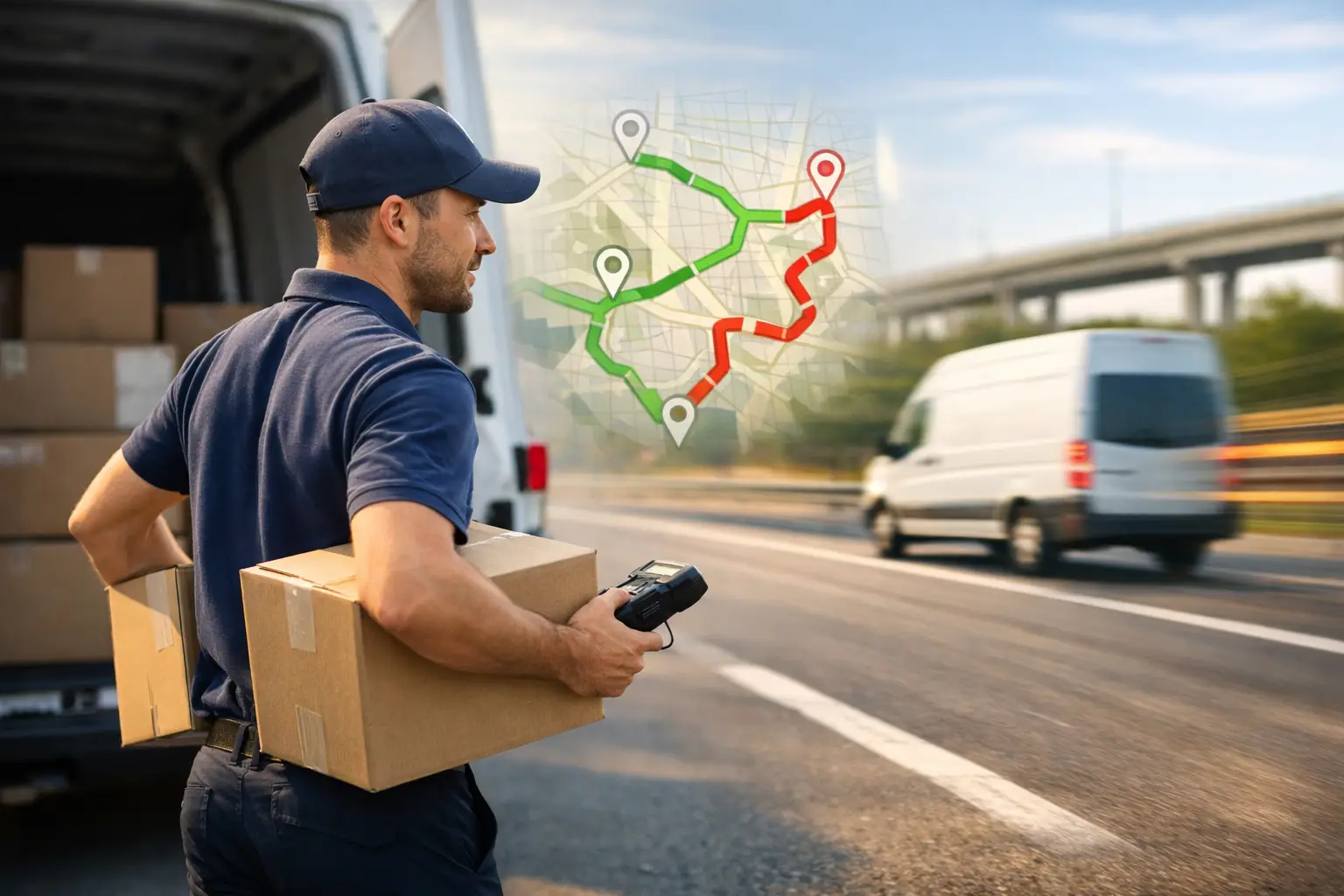
The most visible part of delivery efficiency is stop order. General navigation apps are excellent at getting a driver from point A to point B, but multi-stop work requires a different calculation. The goal is to sequence the entire day around time, distance, traffic, delivery windows, start locations, and practical route constraints.
Planning stops manually can work for a short route with a handful of familiar addresses. It falls apart when volume grows, traffic changes, or multiple drivers share an area. Sorting stops by ZIP code, for example, is quick but imprecise. Two nearby ZIP codes may be separated by a river crossing, a highway bottleneck, or a long stretch of restricted roads.
A route planning tool should let you import or add stops, set the start and end point, account for time-sensitive appointments, and generate an efficient sequence in seconds. RoadWarrior can optimize up to 500 stops per day, helping drivers spend less time arranging pins and more time completing the work.
Optimization is not a one-time event. Check the route before departure, then re-evaluate when a cancellation, late pickup, road closure, or high-priority add-on changes the plan. The best route at 7:00 a.m. may not be the best route at noon.
Reduce Empty Miles Without Overloading Drivers
Empty miles are expensive because the vehicle is moving but not generating value. They happen between scattered stops, during returns to the depot, when territory boundaries are unclear, and when one driver is sent past another driver's service area.
Start by grouping work geographically, but do not stop there. Consider driver start locations, vehicle capacity, skills, and delivery windows. A driver beginning on the west side of town may be the logical choice for a west-side stop even if another driver has a slightly lighter route. The lowest-mile plan on paper can fail if it ignores where people actually start their day.
There is also a limit to route density. Packing every possible stop onto one driver may reduce total fleet miles, yet leave that driver with an impossible schedule and the team with no capacity for urgent work. Keep some room for the real-world disruptions that happen every day. A route that is 95% full can be more productive than one scheduled at 100% with no margin for traffic or service delays.
Make Traffic Part of the Plan, Not an Excuse
Traffic is unavoidable. Repeatedly treating it as a surprise is not. Delivery teams should plan around predictable congestion, school zones, event areas, construction corridors, and the hours when warehouse receiving docks are busiest.
This may mean starting with the farthest stop before traffic builds, serving dense downtown stops outside peak hours, or scheduling commercial deliveries when receiving staff are available. The right choice depends on the route. A residential package route may benefit from a different sequence than a field service route requiring parking, customer access, and longer job times.
Drivers also need navigation that stays useful after the route is built. If conditions change, they should be able to move through stops with clear turn-by-turn guidance and update the team when an exception occurs. A plan only improves execution when drivers can use it without fighting the technology between every stop.
Build a Faster Dispatcher-to-Driver Workflow
For multi-driver operations, delivery efficiency can disappear in the handoff. A dispatcher may have a strong plan, but text messages, phone calls, screenshots, and spreadsheets create confusion once routes are in motion.
Give dispatchers one place to assign stops, see route progress, and make updates. Give drivers one clear route list with the latest instructions. When a stop is reassigned, canceled, or added, the person doing the work should not have to guess whether the old plan still applies.
Set clear rules for exceptions. Drivers should know when they can skip a stop, when they should call the customer, and when they need dispatcher approval. Dispatchers should know which changes justify rerouting the full day versus handling a single stop manually. This reduces the constant back-and-forth that turns a busy route into a chaotic one.
Proof of delivery matters here too. Photos, signatures, notes, and timestamps help resolve customer questions quickly and prevent drivers from retracing their steps to verify completed work. The operational benefit is not just documentation. It is protecting tomorrow's route from yesterday's avoidable disputes.
Improve the System With Weekly Route Reviews
Daily execution creates useful evidence. Review it before the same inefficiencies become habits. Look for routes that consistently run long, stops that fail repeatedly, drivers who encounter the same access barriers, and territories that create unnecessary overlap.
Talk to drivers during these reviews. Route data can show that a stop took 18 minutes; a driver can explain that the building elevator was out, the address leads to the rear entrance, or parking is impossible after 2:00 p.m. Pair data with field knowledge, then update the route rules accordingly.
Test one meaningful change at a time. Adjust service times, redraw a territory boundary, change a warehouse departure window, or add a delivery-day cutoff. Compare the results over several days rather than judging success from one unusually easy or difficult shift. That is how small operational improvements become dependable savings.
The Goal Is a Better Shift, Not Just a Shorter Map
Higher delivery efficiency gives drivers a route they can execute with confidence and gives managers a clearer view of where time and money are going. It means fewer unnecessary turns, fewer fuel-wasting detours, less dispatch confusion, and more completed work per shift.
Start with tomorrow's route: clean the stop data, sequence the full day instead of the next stop, and leave room for reality. When every mile has a purpose, your team can crush the route without letting the route crush the team.
Tags