

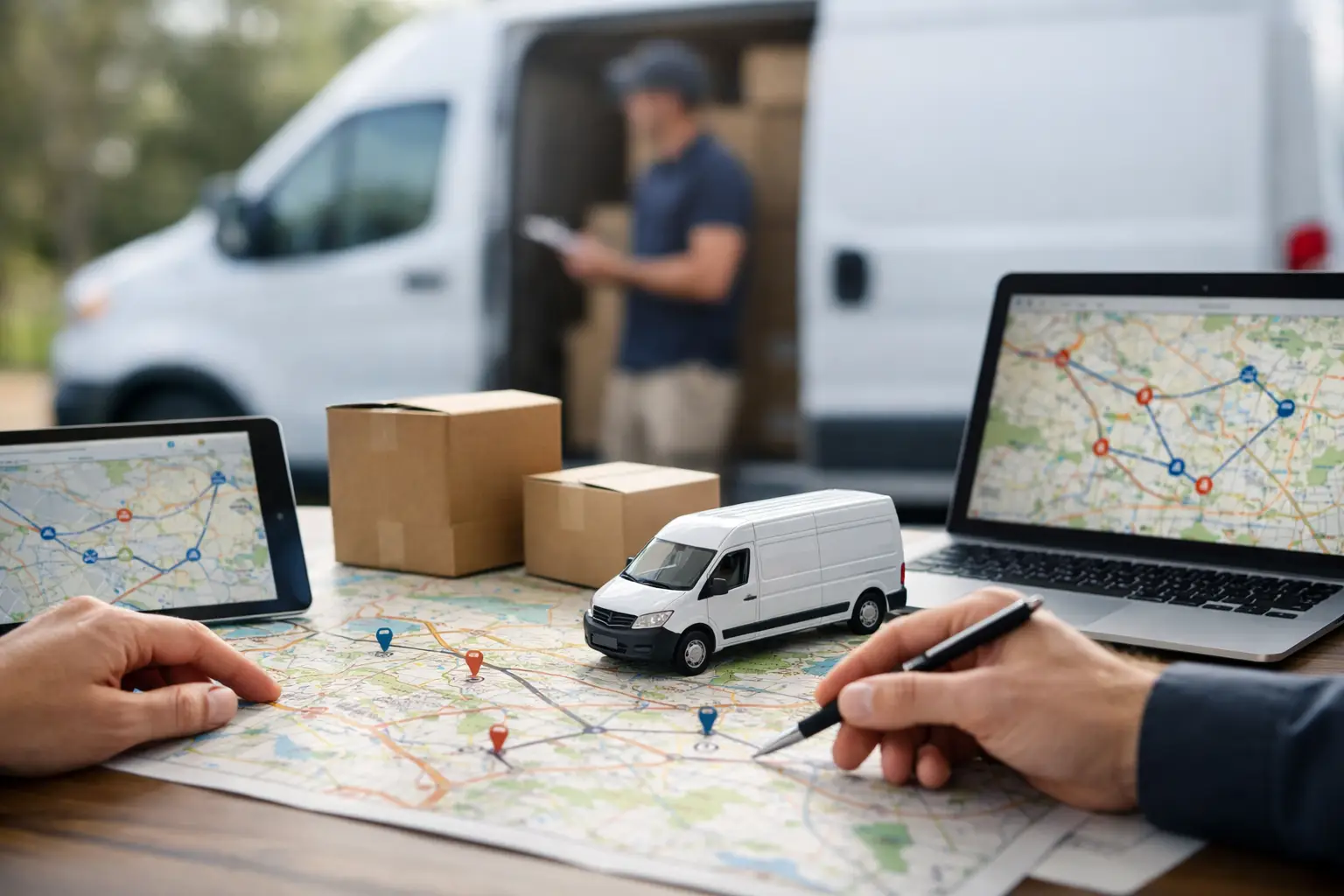
How to Assign Delivery Routes That Work
RoadWarrior Team
If your drivers leave the lot with uneven workloads, overlapping territories, or stops in the wrong order, the day gets expensive fast. Learning how to assign delivery routes well is not just a dispatch task - it is one of the clearest ways to cut miles, reduce fuel spend, and help your team finish stronger.
The challenge is that route assignment looks simple until real-world variables show up. One driver has a van with limited capacity. Another knows a downtown zone better than anyone else. A few customers need delivery before noon. Traffic will build by 8:30. Suddenly, dragging pins around a map or splitting stops by gut feel stops working.
The good news is that a solid route assignment process is not complicated. It just needs to be structured. When you assign routes based on stop density, timing, driver availability, and actual road conditions, you give your team a better shot at hitting every stop without wasting the day.
How to assign delivery routes without the usual guesswork
Start with the stops, not the drivers. That sounds backward, but it prevents one of the most common mistakes: building routes around habit instead of actual demand. Look at every stop for the day and identify what matters most - service windows, delivery priority, order size, vehicle needs, and geography.
Once you know the shape of the work, group stops into logical route zones. In some operations, this is based on simple geography such as north, south, east, and west. In others, it is based on delivery type, customer priority, or time sensitivity. The key is that each route should make sense on the road, not just on a spreadsheet.
After that, match those route groups to available drivers. This is where dispatchers often run into trade-offs. Your fastest driver may be able to handle a dense urban route, but if that same route has bulky orders and the driver has the wrong vehicle, speed alone will not save the plan. The best assignments balance skill, capacity, and route complexity.
Finally, sequence the stops in the most efficient order. This is where route optimization matters. Assigning a driver 25 stops in the same area is a start, but if those stops are visited in a poor sequence, you still lose time and fuel. Good route assignment includes both who gets the stops and the order in which they should be completed.
The inputs that matter most when assigning routes
A lot of route problems start because teams use incomplete inputs. If you only assign by ZIP code or neighborhood, you miss the details that create delays later.
Delivery windows should be near the top of the list. A route with ten flexible stops and two strict morning deliveries should be built around those time commitments first. If you ignore that, the route may look efficient on a map but fail in the field.
Stop volume matters too. Not all stops take the same amount of time. A quick drop-off is not the same as a signature-required delivery, a large item handoff, or a service visit that takes 20 minutes on site. If one driver gets a route with fewer stops but heavier service time, that route may already be full.
Vehicle constraints are another factor teams underestimate. Weight, cargo space, refrigeration needs, and even parking access can change who should take a route. The same goes for driver start locations. If one driver begins from a home base closer to the first cluster of stops, forcing them to cross town just to keep territories neat may cost more than it saves.
Then there is traffic. Static route assignment breaks down quickly if it ignores when roads get congested. A route that works at 7:00 a.m. may be a mess by 9:00. If you want to crush your routes, assign them with realistic traffic expectations built in.
How to balance routes across drivers
Fair does not always mean equal. That is one of the biggest mindset shifts in route planning. If you give every driver 20 stops, you may still create major imbalance because those stops can vary widely in drive time, service time, and difficulty.
A better approach is to balance by total workload. That includes estimated drive time, stop count, on-site time, and any special handling requirements. One route might have fewer stops but a much longer completion time. Another may have more stops but tighter clustering and faster turnover.
You also need to account for driver familiarity. There are cases where keeping a driver in a known territory improves performance and customer service. There are also cases where relying too much on familiar territories creates bottlenecks and makes your operation fragile when someone calls out sick. It depends on the size of your team and how standardized your routes are.
For smaller delivery businesses, route balancing often comes down to this question: will this assignment get everyone back at roughly the same time without forcing overtime or rushed deliveries? If the answer is no, rework the load before wheels are moving.
When manual route assignment still makes sense
Manual assignment is not always wrong. If you have a low stop count, stable territories, and the same drivers every day, a dispatcher may be able to assign routes quickly from experience. That local knowledge has value.
But manual methods start to crack when stop counts rise, last-minute orders come in, or customer time windows tighten. That is usually the tipping point where spreadsheets, map tabs, and memory create more rework than control. If dispatch is spending too much time reshuffling routes each morning, the process is already costing you.
When software gives you a real advantage
Route planning software becomes especially useful when you need to assign many stops across multiple drivers, optimize stop order, and adjust for constraints at speed. Instead of eyeballing clusters and guessing the best sequence, you can build routes around actual road logic.
That matters because the fastest-looking route on a map is not always the fastest route in real life. Left turns, traffic patterns, appointment windows, and service duration all affect the outcome. A dedicated route planner helps you make assignments based on execution, not theory.
For teams, software also improves handoff from dispatcher to driver. A route is not truly assigned until the driver has clear stop order, navigation, and updates in one place. That is where a platform like RoadWarrior can help teams move from planning to execution without the usual back-and-forth.
A practical process for assigning delivery routes each day
The best daily workflow is simple enough to repeat and strong enough to handle change. Start by importing or collecting all stops for the day in one place. Clean up addresses, confirm any time-sensitive orders, and flag special handling needs before assignment starts.
Next, review available drivers, vehicle capacity, and start locations. If someone is out or a vehicle is down, adjust the plan early instead of patching it later.
Then create route groupings based on geography and delivery constraints. Once those groups are built, run route optimization to determine the most efficient stop sequence within each route. After that, compare workloads across drivers and make small adjustments where needed.
Before dispatch, do a quick sanity check. Look for routes with too much windshield time, too many early commitments, or stop clusters that seem out of place. Then send the routes to drivers with clear instructions and navigation built in.
During the day, stay flexible. The best route assignment process includes room for exceptions. A customer may reschedule. A driver may hit a delay. A new urgent stop may need to be inserted. Good dispatch is not just about the first plan - it is about making smart adjustments without blowing up the rest of the day.
Common mistakes that make route assignments fail
One of the biggest mistakes is assigning routes based only on territory lines. Territories are useful, but if daily stop volume shifts, rigid boundaries can create overloaded drivers in one zone and underused capacity in another.
Another issue is ignoring service time. Dispatchers often focus on drive time because it is easier to see, but long stops can quietly wreck a route. If a driver has multiple deliveries that require setup, signatures, or customer interaction, those minutes add up fast.
Late route changes are another common problem. If assignments change after drivers have already started moving, confusion follows unless the update process is clean. That is why driver communication matters as much as route design.
Finally, many teams fail to review route performance after the fact. If one route runs late every Thursday, that is not bad luck. It is a planning signal. Look at route completion times, miles driven, and stop success rates so tomorrow's assignments keep improving.
The goal is not to build a perfect route plan every day. It is to build a repeatable system that helps your drivers waste less time, burn less gas, and finish more stops with less stress. When route assignment gets smarter, the whole operation gets sharper - and that is how you give your team a real daily edge.
Tags