

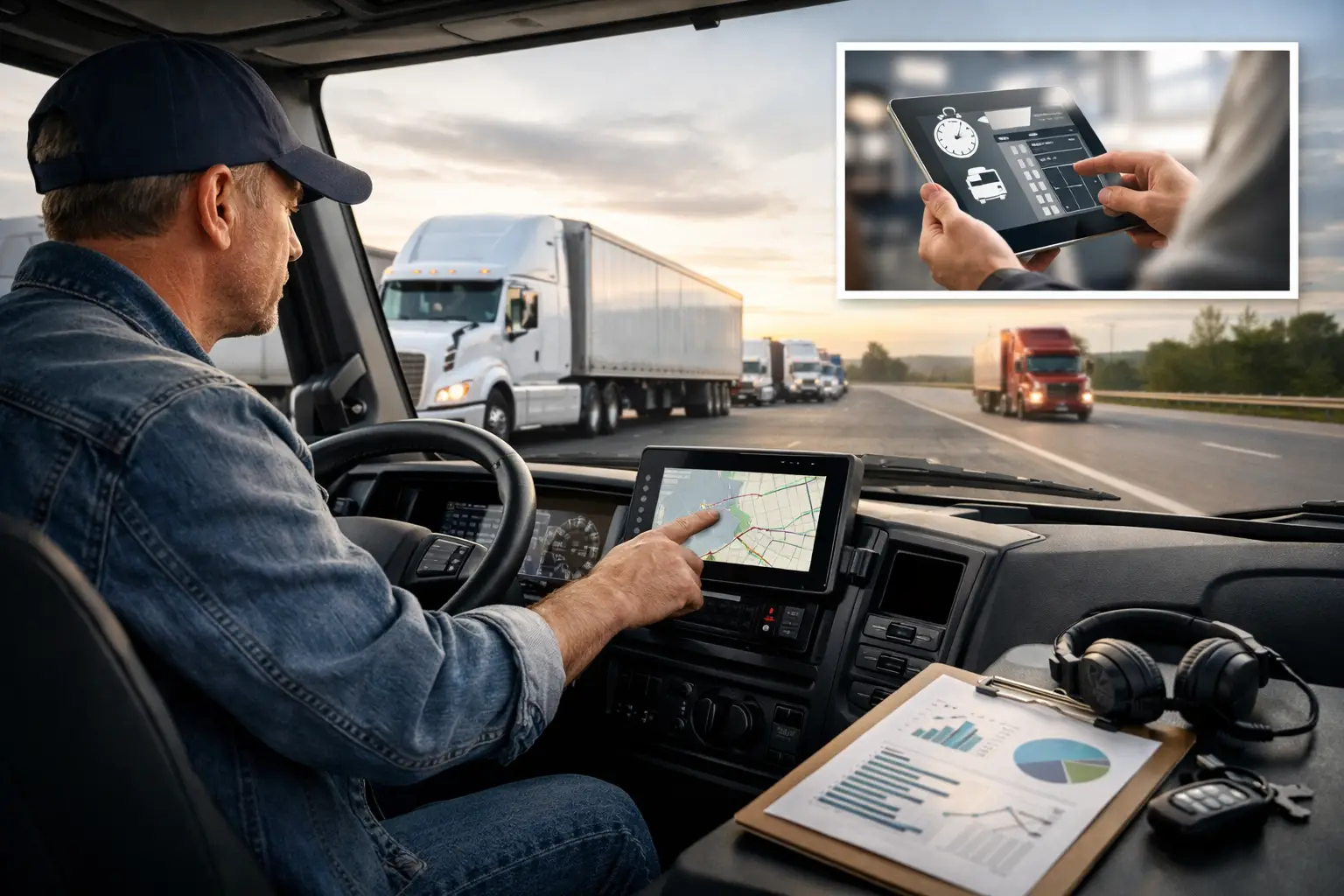
7 Ways to Improve Truck Driver Efficiency
RoadWarrior Team
A driver loses 20 minutes at the first stop because the route was built in the wrong order. Then traffic stacks up, fuel burn climbs, and the whole day gets tighter from there. That is how truck driver efficiency gets lost - not in one big failure, but in small delays that compound across every mile and every stop.
For owner-operators, delivery businesses, and fleet teams, efficiency is not a soft metric. It affects fuel cost, on-time performance, customer satisfaction, driver stress, and how many jobs fit into a shift. The good news is that most efficiency gains do not require a full operational overhaul. They come from fixing route planning, reducing idle time, tightening communication, and giving drivers better tools to execute the day.
What truck driver efficiency really means
Truck driver efficiency is usually framed as speed, but that is only part of it. A driver who moves fast while backtracking across town, idling at every stop, or missing delivery windows is not operating efficiently. Real efficiency means completing the right number of stops, in the right order, with the fewest wasted miles and the least avoidable downtime.
That includes route quality, fuel use, stop time, paperwork, dispatch coordination, and navigation accuracy. It also includes the human side. If the plan is chaotic, the driver spends the day recovering instead of executing. If the route is tight but realistic, the work feels more controlled and the results improve.
1. Build better routes before the wheels move
The biggest efficiency win usually happens before a truck leaves the yard. Many teams still sequence stops manually or rely on basic map tools that were never designed for multi-stop operations. That creates hidden waste fast. One bad route order can add extra miles, push drivers into heavier traffic, and turn a manageable day into a scramble.
A better route plan accounts for stop priority, service windows, traffic patterns, and drive time between jobs. It should also reflect how the day actually works on the ground. A route that looks efficient on a static map can fail if it sends a driver across a busy corridor at the worst possible hour.
This is where specialized route planning earns its keep. For multi-stop work, optimized sequencing gives drivers a clean plan instead of a puzzle to solve from the cab. When dispatchers and drivers start with a smarter route, they can crush their routes with less guesswork and fewer course corrections.
2. Cut deadhead miles and unnecessary detours
Extra miles do more damage than most operators realize. They burn fuel, add wear to the vehicle, reduce available capacity for more stops, and put pressure on delivery windows. Over a day or a week, a handful of unnecessary detours can turn into a serious cost.
Some deadhead miles are unavoidable. The last stop may be far from the next pickup, or a rural service area may force longer transitions. But many wasted miles come from preventable issues like poor stop order, duplicate coverage, missed turns, or drivers choosing their own route because the original one was not practical.
If you want to improve truck driver efficiency, start tracking where those miles come from. Look for routes with repeated overlap, long return legs, or frequent manual changes. You do not need perfect route density to improve. You need visibility into where the route is leaking time and fuel.
3. Reduce dwell time at each stop
Not every efficiency problem happens on the road. A lot of time gets lost with the truck parked. Drivers wait for signatures, search for the right entrance, call customers who are not ready, or sort paperwork at the curb. These pauses seem minor one by one, but they stack up across ten, twenty, or fifty stops.
The fix is usually operational discipline, not driver pressure. Clear stop notes, proof-of-delivery workflows, accurate customer information, and consistent dispatch instructions all shorten time on site. So does planning routes with realistic service times instead of pretending every stop takes the same number of minutes.
There is a trade-off here. If you squeeze schedules too hard, drivers rush, mistakes increase, and customer interactions suffer. Better stop execution is about removing friction, not forcing drivers to sprint through every task.
4. Give drivers navigation built for route work
General navigation apps are fine for getting from point A to point B. They are much less useful when a driver needs to hit a long list of stops in the most efficient order while adapting to real traffic and business constraints. That gap matters more as stop counts rise.
Drivers should not have to bounce between a spreadsheet, text messages, and a map app just to finish the day. That kind of workflow creates distraction and missed turns. A route-based navigation setup keeps the stop list, the sequence, and turn-by-turn guidance working together.
For teams, the value is even bigger when dispatch and driver views stay aligned. If the office updates a route, the driver should not be left working from stale instructions. RoadWarrior is built for exactly that kind of field execution - fast route planning, practical navigation, and tighter dispatcher-to-driver coordination without a complicated rollout.
5. Improve dispatch communication without adding noise
Poor communication kills efficiency in two directions. Sometimes drivers do not get critical updates fast enough. Other times they get flooded with calls and messages that break concentration and slow execution. Neither helps.
The goal is simple: fewer surprises, clearer handoffs, and less back-and-forth. Drivers need the right stop details before arrival, not three separate calls after they are already parked. Dispatchers need visibility into progress so they can make adjustments early instead of reacting after delays have already spread through the route.
This matters even more for teams handling changing schedules, customer exceptions, or urgent add-ons. The right workflow gives managers control without micromanaging from a distance. Drivers stay focused, dispatch stays informed, and the day keeps moving.
6. Train for repeatable habits, not heroics
Some operations lean too hard on their best drivers. Those drivers know every shortcut, remember every tricky stop, and recover when the plan falls apart. That can keep the business moving, but it does not create scalable efficiency.
A stronger operation builds repeatable habits that average drivers can follow consistently. That means standard route prep, pre-trip checks, fuel-conscious driving, accurate status updates, and a clean process for handling issues at the stop. When those habits are documented and reinforced, performance stops depending on one or two veterans carrying the load.
It also makes onboarding easier. New drivers become productive faster when the route system is clear and the process is supported by tools rather than tribal knowledge.
7. Measure the right efficiency metrics
If you only track total stops completed, you will miss what is really happening. A route can hit its stop count while still wasting miles and labor. Better metrics tell a fuller story.
Look at miles per stop, on-time rate, average stop duration, idle time, route completion time, and how often routes are manually reworked mid-day. For teams, compare planned versus actual execution. That is where inefficiency becomes visible.
Be careful not to chase one metric so hard that another gets worse. The shortest route is not always the best route if it causes missed time windows. The fastest driver is not always the most efficient if fuel use is high or service quality drops. Efficiency works best as a balance of time, cost, and execution quality.
Truck driver efficiency gets better when the day gets simpler
Most drivers do not need more hustle. They need a cleaner route, fewer wasted miles, better stop information, and less confusion between dispatch and the road. That is what moves the needle.
The best operations make efficiency feel ordinary. The route makes sense. The navigation is ready. The stop details are there. The driver spends less time fixing the plan and more time running it. When that happens consistently, fuel spend falls, deliveries tighten up, and getting home earlier stops feeling like luck.
Tags