

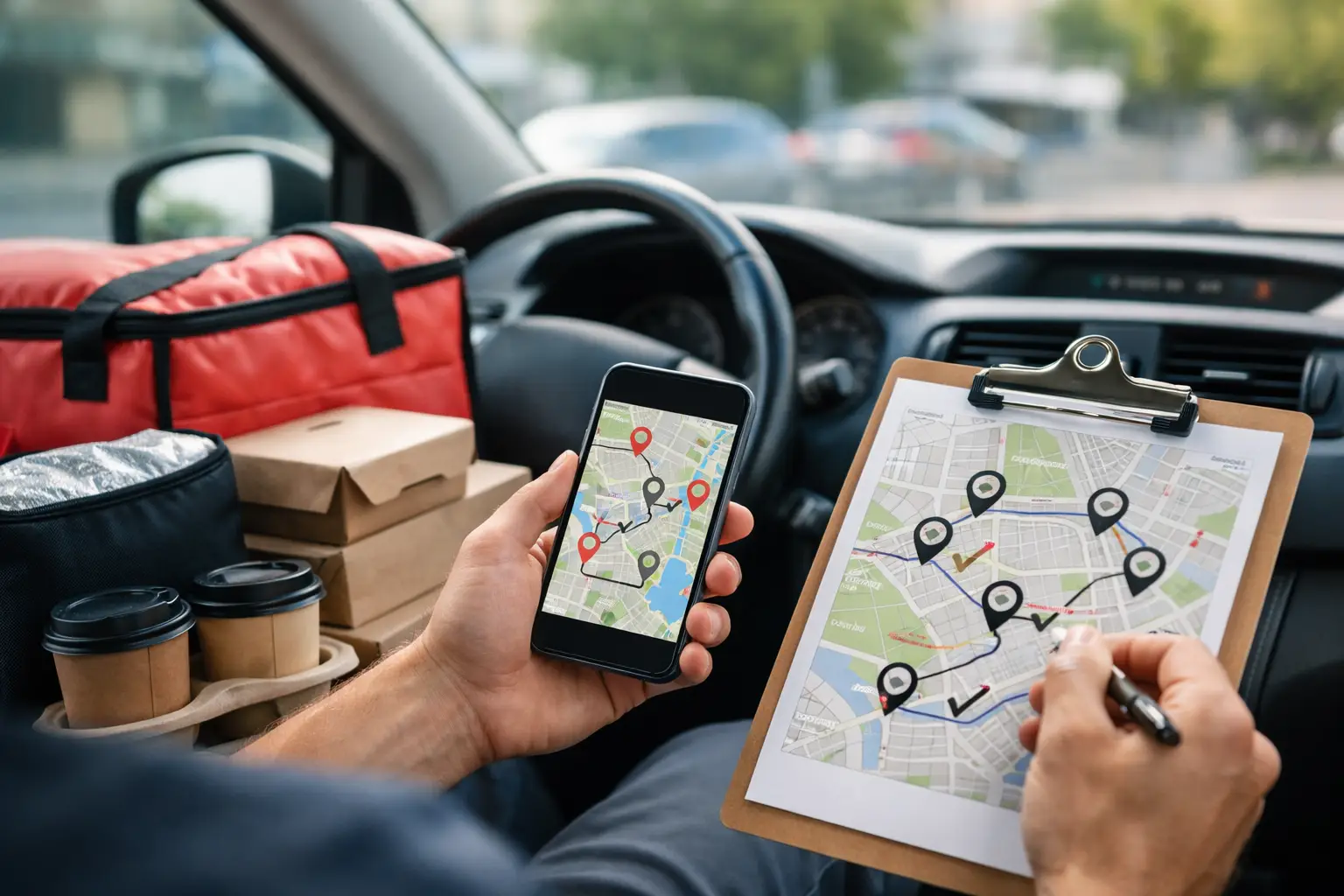
Multi Stop Planning for Food Delivery That Pays
RoadWarrior Team
The difference between a profitable food delivery shift and a frustrating one is often decided before the driver starts the car. Multi stop planning for food delivery turns a stack of orders into a workable route, helping drivers spend less time backtracking, avoid late drop-offs, and keep hot food hot. When every mile has a cost, the order of your stops matters.
A map app can show directions to one restaurant or one customer. It cannot reliably build the smartest sequence for a full shift with pickup windows, delivery promises, traffic, parking, and changing order readiness. Food delivery is fast-moving work. Your route plan needs to be just as responsive.
Why Multi Stop Planning for Food Delivery Matters
Food delivery routes have a built-in conflict: restaurants need time to prepare orders, customers expect accurate ETAs, and drivers need enough stops per hour to make the work pay. A route that looks shortest on a map may fail in practice if it sends you to a restaurant before the order is ready or leaves a customer’s meal sitting in the car while you make unnecessary loops.
Good planning reduces that friction. Instead of choosing the next stop based on instinct, drivers can organize pickups and drop-offs around distance, traffic, service times, and delivery priority. The payoff is direct: fewer empty miles, less fuel burned, more completed orders, and a better customer experience.
This is especially valuable for catering, meal-prep services, bakery runs, grocery-to-door delivery, and independent couriers handling several orders at once. Those operations often have a fixed set of deliveries and limited time to complete them. One inefficient stop sequence can put the entire route behind schedule.
Start With the Real Constraints, Not Just Addresses
The fastest route is not always the right route. Food delivery planning works best when it accounts for the conditions that actually affect the shift.
First, separate pickups from deliveries. A driver may need to collect from several restaurants, but those pickups should not automatically happen in the order they appear on a dispatch screen. Consider preparation times, holding temperature, and how far each customer is from the pickup location. Picking up a pizza first and delivering it last might add five minutes to the route, but it can cost repeat business.
Next, identify orders with hard deadlines. Catering orders for an office lunch, scheduled meal deliveries, and time-sensitive grocery orders need priority. Build the route around those commitments, then fit flexible orders into the remaining space. If an order can be delivered within a 20-minute window, it gives you more room to optimize than an order expected at noon sharp.
Traffic deserves the same attention. A route that is efficient at 10:30 a.m. may be a bad plan at noon near a business district, school zone, or stadium. Planning around predictable congestion helps drivers avoid sitting in traffic with food cooling in the back seat.
Finally, account for service time at each stop. Apartment complexes, hospitals, campuses, and secured office buildings can take far longer than a curbside residential drop-off. Add realistic time for parking, elevator access, customer handoff, and proof of delivery. Otherwise, a route can look perfect on paper and fall apart by the third stop.
Build Routes in the Right Order
For drivers handling a handful of orders, planning can be as simple as checking each destination, grouping nearby stops, and arranging them into a logical loop. Once you reach 10, 20, or more stops, manual planning becomes expensive. The chance of missing a better sequence rises with every added address.
A reliable workflow starts with clean stop information. Confirm the restaurant name, street address, unit number, customer contact details, and any delivery notes before building the route. Bad data creates bad routes. A missing apartment number or duplicate address can burn more time than any optimization can save.
Then group stops geographically, but do not stop there. Two customers may be near each other, yet one order may not be ready for another 15 minutes. In that case, take the ready order to a nearby customer first, return toward the restaurant cluster, and pick up the delayed order when it makes sense. The best route balances geography with timing.
Route optimization software earns its place when volume increases. It evaluates possible stop sequences much faster than a driver can, then creates an efficient route based on the inputs available. RoadWarrior can organize up to 500 stops per day, making it useful for operators who have outgrown single-destination navigation but do not need a complicated enterprise system.
Choose a Route Goal Before You Optimize
Not every delivery route should be optimized for the same outcome. If all orders are ready and have similar deadlines, minimizing total drive time or mileage is usually the right goal. If a few deliveries have promised time windows, on-time arrival needs to take priority, even if it adds a few miles.
For high-value catering or recurring business clients, protect service quality first. For flexible same-day deliveries, efficiency may be the bigger lever. The key is to make that choice deliberately instead of letting the route happen by accident.
Replan When the Shift Changes
No food delivery shift stays static. A restaurant runs behind. A customer changes instructions. A road closes. A new order arrives while the driver is already moving. Drivers who cling to the original route after conditions change can lose more time than they save.
Replanning does not mean rebuilding everything for every small delay. It means recognizing when the existing sequence no longer makes operational sense. If a pickup is delayed by 20 minutes, move that stop later and complete nearby deliveries first. If a customer asks for a contactless drop-off, adjust the expected service time. If traffic blocks the direct route, use current traffic data and redirect before the delay multiplies.
For teams, this is where dispatcher visibility matters. A dispatcher who can see route progress can reassign a late pickup, shift a new order to the nearest available driver, or update stops without a chain of texts and phone calls. That keeps drivers focused on delivery execution instead of trying to solve dispatch problems from the road.
Protect Food Quality Along With Route Efficiency
Cutting miles is a major win, but food delivery has a quality standard that package delivery does not. The route must keep meals in the best condition possible from pickup to handoff.
Use insulated bags and separate hot and cold items whenever the order requires it. Secure drinks, sauces, and delicate containers so an efficient route does not become an expensive remake. More importantly, avoid collecting food too early. If an order is ready well before its customer should be served, it may be better to make a nearby delivery first or delay the pickup by a few minutes.
This is one reason simple nearest-stop planning can fail. The nearest stop might be a pickup, but the food could wait in the vehicle while you complete deliveries in the opposite direction. A smarter plan considers what is in the car, how long it has been there, and what the customer expects when the bag reaches the door.
Measure the Results That Affect Your Bottom Line
Better multi-stop planning should show up in the numbers. Track average miles per delivery, drive time, deliveries completed per hour, late orders, fuel spend, and customer complaints. You do not need a complex reporting process to find useful patterns. Compare a few weeks of manual routing with a few weeks of optimized routes, then look at the differences.
Pay attention to repeat problem areas. If a certain restaurant is consistently late, build more pickup buffer into routes that include it. If deliveries to downtown apartments take twice as long as expected, update your stop time assumptions. Route planning improves when it learns from the actual work, not just the map.
For owner-operators, even small gains add up. Saving 15 miles a day can reduce fuel costs and vehicle wear over a month. Completing one or two additional deliveries in a shift can change daily earnings. For a team, those same improvements compound across every driver and every route.
Make the Route Easy to Execute
A perfect plan is useless if the driver cannot follow it under pressure. Keep route instructions clear, delivery notes visible, and navigation ready for the next stop. Drivers should not need to manually re-enter every address or guess which order belongs to which customer while parked on a busy street.
Before leaving the pickup zone, do one quick check: confirm the order count, verify fragile items, review the first few stops, and make sure the route matches the food in the vehicle. That minute of preparation can prevent a wrong turn, missed item, or late delivery later.
Food delivery is a race against distance, traffic, and the clock. Plan the stops with the realities of the job in mind, adjust when conditions change, and let every mile work harder. That is how drivers protect their earnings, keep customers happy, and get home earlier after a shift well run.
Tags