

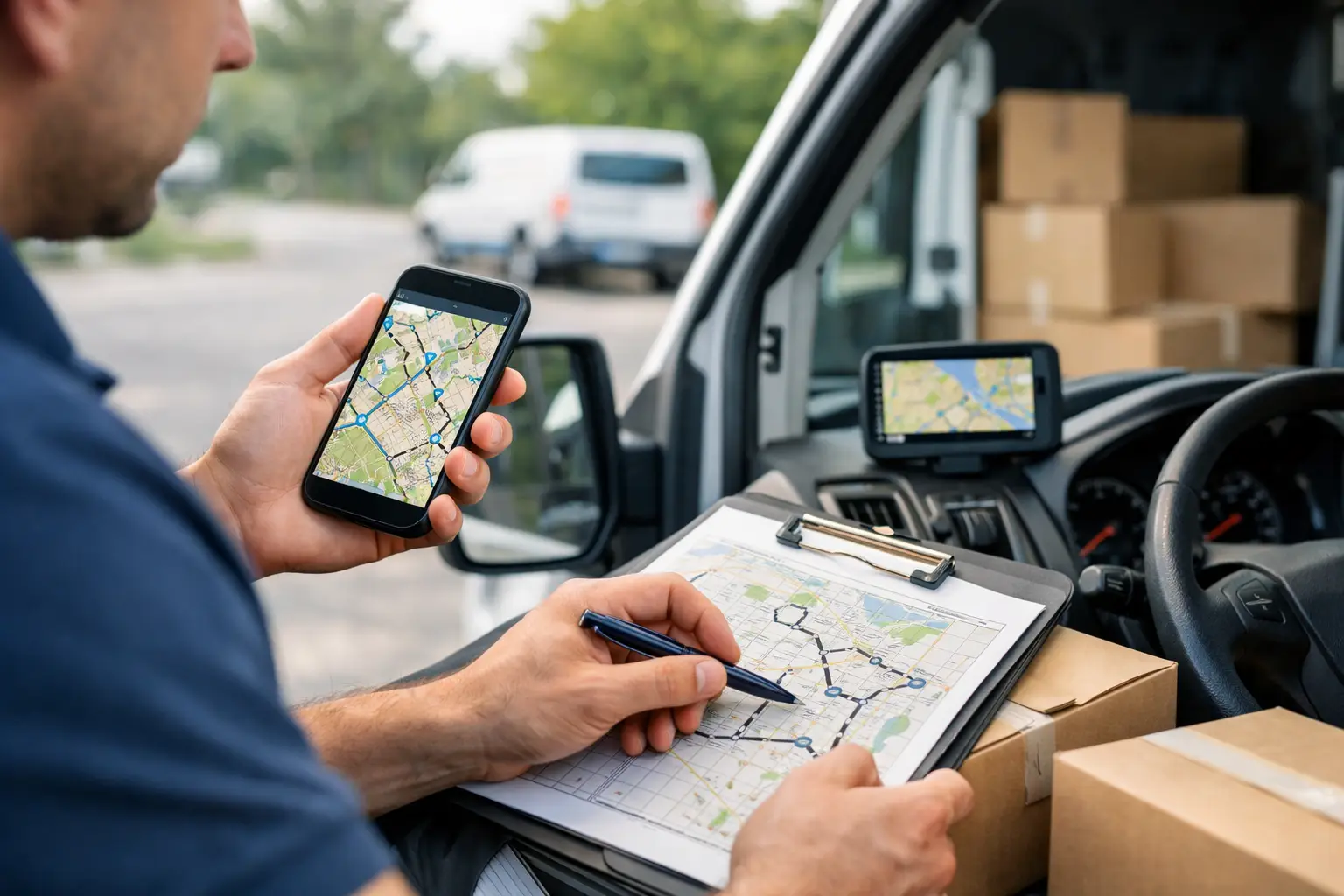
Route Planning for Couriers That Cuts Miles
RoadWarrior Team
A courier route can look profitable when the jobs come in and unprofitable by the time the last package is delivered. A few unnecessary miles between stops, one missed delivery window, and 20 minutes spent rebuilding a route after traffic hits can erase the margin fast. Route planning for couriers is how drivers turn a list of addresses into a workable day - one that protects fuel, time, customer expectations, and the chance of getting home on schedule.
The goal is not simply to find the shortest line between stops. Couriers deal with pickup deadlines, apartment access, business receiving hours, vehicle capacity, service zones, traffic, and customers who need a specific delivery time. A good plan puts those realities first, then finds the most efficient order for the work.
Why Manual Courier Routes Cost More Than They Seem
Many drivers start with a spreadsheet, a text thread, or a list of stops in a general navigation app. That may be manageable for five deliveries. It gets expensive when the list grows, especially when stops arrive out of order or a dispatcher needs to make changes during the day.
The visible cost is fuel. The less obvious cost is time spent deciding where to go next, backtracking across town, calling customers because an arrival window was missed, and taking routes that look reasonable on a map but perform poorly in real traffic. For an owner-operator, that can mean fewer completed jobs. For a courier team, it can mean late deliveries, overtime, and dispatchers stuck reacting instead of coordinating.
Google Maps is excellent for navigating from one point to another. It is not built to organize a complex, multi-stop courier route around your operational priorities. When you have dozens of stops, the sequence matters as much as the directions.
Route Planning for Couriers Starts With Better Stop Data
Route optimization cannot fix unclear job information. Before building a route, make sure every stop includes a complete address, contact details, delivery notes, and any timing requirement. If a stop requires a signature, has a loading-dock entrance, or cannot be serviced before 10 a.m., that information needs to travel with the job.
This is especially useful for mixed routes. A medical courier may have pickup deadlines before delivery deadlines. A local delivery business may have residential drops alongside commercial locations with narrow receiving hours. A field service technician may need a specific part in the vehicle before taking a job. These are not minor details. They determine whether an efficient-looking route is actually feasible.
Clean stop data also reduces driver calls. Instead of searching for suite numbers or asking which entrance to use, drivers can move from stop to stop with the instructions they need already attached to the route.
Protect Time-Sensitive Stops First
Not every stop has equal priority. A package with a hard customer appointment should not be treated the same as a doorstep delivery that can happen any time before the end of the day. Start by identifying hard constraints: scheduled pickups, promised delivery windows, business closing times, and high-priority customers.
Then organize the flexible stops around those fixed commitments. This is where manual planning often falls short. A route that saves two miles but causes a driver to arrive 15 minutes after a receiving department closes is not optimized. It is a failed delivery waiting to happen.
Use Territories Without Letting Them Create Waste
Territories help courier teams reduce overlap. If one driver covers the north side and another handles the south side, dispatch is simpler and drivers learn their areas. But rigid territories can create unnecessary miles when one driver has 60 stops and another has 20 nearby.
The right approach depends on your volume and service promise. For predictable daily work, fixed territories may be the best choice. For variable demand, it often makes more sense to balance workloads while keeping drivers within logical geographic zones. The goal is not perfect equality. It is completing the work on time without sending drivers on avoidable cross-town runs.
Build a Route That Works in the Real World
The best courier route is usually a balance between mileage, drive time, and delivery commitments. If you optimize only for distance, you may send a driver through a congested area at the wrong time. If you optimize only for fastest travel time, you may create a longer route that burns more fuel. The right setting depends on the work, the market, and what customers expect.
Start with the full stop list, then let route optimization calculate an efficient sequence. After that, apply common sense. Check for stops that must happen first, known parking problems, access restrictions, or a pickup that needs room in the vehicle. Technology should do the heavy math, while the driver or dispatcher applies local knowledge.
For example, a courier serving downtown businesses may want commercial deliveries completed before lunch, when loading zones and elevators become more difficult. A suburban residential route may be more efficient when grouped by neighborhood, even if one farthest stop is not technically first in the sequence. A strong plan accounts for the work on the ground, not just points on a map.
Plan for Change, Not Perfection
No route stays static all day. A customer may not be available. A priority pickup may appear at 11 a.m. Traffic can turn a 10-minute drive into a 30-minute delay. The answer is not to throw out the route at the first disruption. It is to make controlled adjustments.
Keep the next few critical stops protected, then reoptimize the remaining work when a meaningful change occurs. Rebuilding the route after every small event can create confusion and lead drivers to second-guess the plan. Waiting too long creates wasted miles. The sweet spot is responding quickly to changes that affect service windows, capacity, or a large section of the route.
This is where a purpose-built route planner earns its place. RoadWarrior can optimize multi-stop routes, account for traffic and route constraints, and give drivers GPS delivery navigation without forcing them to manually map every address. For teams, dispatchers can coordinate work while drivers stay focused on execution.
Make Dispatch and Drivers Work From the Same Plan
Courier operations slow down when dispatch has one version of the day and drivers have another. A dispatcher may update a spreadsheet while the driver is already following an old sequence. Or a driver finds an issue at a stop but has no simple way to communicate what happened. Those gaps create duplicate calls, missed jobs, and frustrated customers.
A shared route workflow gives everyone the same operating picture. Dispatch can assign stops, see whether work is progressing, and make changes when needed. Drivers receive a route that is ready to run, with navigation and stop notes in one place. The result is less time spent asking, “What should I do next?”
For smaller courier businesses, this can be the difference between operating professionally and operating from a group text. For larger teams, it creates control without requiring a complicated enterprise system.
Measure the Results That Affect Profit
You do not need a complicated analytics program to know whether route planning is improving your operation. Track a few numbers consistently: miles per route, stops completed per hour, on-time delivery rate, fuel spend, and the amount of time drivers spend planning or waiting for instructions.
Look at trends over several weeks rather than judging one unusually busy day. A route might take longer because of weather, a major accident, or a customer issue outside the driver's control. But if total miles and average route time keep falling while on-time performance holds steady, the process is working.
It is also worth measuring driver experience. Routes that are constantly overloaded or poorly sequenced lead to rushed work and turnover. The best plans reduce wasted driving without treating drivers like map pins. When the route is practical, drivers can complete more work with less stress.
A Better Route Gives You More Than a Faster Day
Couriers are judged on reliability, not just speed. Customers remember late packages, missed pickup windows, and vague arrival updates. They also notice when deliveries show up when promised. Better route planning gives you the operational control to deliver that consistency while cutting the miles that do not add value.
Start with accurate stop information, protect time-critical work, optimize the sequence, and adjust only when conditions truly change. Then watch what happens to fuel, route time, and completed deliveries. The fastest way to crush your routes is often simple: stop driving the day in the order the addresses happened to arrive.
Tags